
The best time to visit Sapa is late September to November, when days are mostly dry and clear, highs sit around 16–22°C and the cloud season begins; March and April are the second window. June to August is green but wet, with more than 380 mm of rain a month. December to February is cold, often foggy and quiet, with highs near 12–14°C and frost on Fansipan most winters.
Sa Pa sits at about 1,500–1,600 m, so it is 8–10°C cooler than Hanoi all year. Snow in town is rare; the last widely reported fall was in January 2016.
Sapa weather by month
These averages come from the long-run record of the Sa Pa weather station, at 1,570 m, used in Vietnam’s building climate standard. Day highs are mild all year; what changes is the rain, the cloud and how cold the nights get.
| Month | Average high | Average low | Rainfall | What to expect |
|---|---|---|---|---|
| January | 12°C | 6°C | 70 mm | Coldest month; frost likely on Fansipan |
| February | 14°C | 8°C | 74 mm | Drizzle and mist; Tet 2027 falls on 6 Feb |
| March | 18°C | 11°C | 105 mm | Warming up; spring blossom |
| April | 21°C | 14°C | 213 mm | Pleasant; showers increase |
| May | 22°C | 16°C | 341 mm | Water fills the terraces |
| June | 23°C | 18°C | 381 mm | Rice planted; frequent rain |
| July | 23°C | 18°C | 461 mm | Wettest month; terraces at their greenest |
| August | 23°C | 17°C | 452 mm | Green to gold late in the month |
| September | 22°C | 16°C | 303 mm | Golden rice, peak mid-month |
| October | 19°C | 14°C | 201 mm | Harvest ends; clearer, cooler days |
| November | 16°C | 10°C | 106 mm | Dry, clear; cloud season |
| December | 13°C | 7°C | 66 mm | Driest month; cold nights, fog |
Rain falls on more days than the totals suggest. October has about 19 rainy days but only 200 mm, and February about 16 days and 74 mm: in the cool months that usually means drizzle and mist rather than downpours. From May to August it is heavy, often afternoon rain, on 22–26 days a month.
The best time to visit Sapa, season by season
Late September to November: clear and cool
This is the stretch most guides, and most trekkers, favour. Rain falls away sharply after September, highs drop from about 22°C to 16°C, and the views across the Muong Hoa valley are at their clearest. By mid-October the terraces are harvested and brown rather than gold, but the walking is easy and the cloud season is starting.
December to February: cold, foggy and quiet
Highs of 12–14°C and lows of 6–8°C, with colder spells. Fog can sit in the valley for days and then lift in an hour. The station logged −4.2°C in January 2016, and Fansipan saw frost in November 2025 and January 2026 and a brief snowfall in late January 2025. Crowds are thinner, except over New Year and Tet.
March to May: spring
Temperatures climb from about 18°C to 22°C, fruit trees blossom in March, and rain builds through April and May. In May and June farmers flood the terraces, which turn into stepped mirrors.
June to August: green and wet
The terraces are at their greenest, especially in July and August, but this is also the wettest season: 381–461 mm a month, heavy fog on Fansipan and a higher risk of landslides on mountain roads. Vietnamese school holidays make weekends busy.
Rice terraces, clouds and snow: when to see them
| If you want | Go in | Notes |
|---|---|---|
| Water-mirror terraces | May–June | Fields flooded for planting |
| Green terraces | July–August | Lushest, but wettest |
| Golden rice | Late August–September | Peak mid-September; harvested by mid-October |
| A sea of clouds | October–March | November and December are the favourites |
| Frost or snow on Fansipan | Late December–February | Never guaranteed |
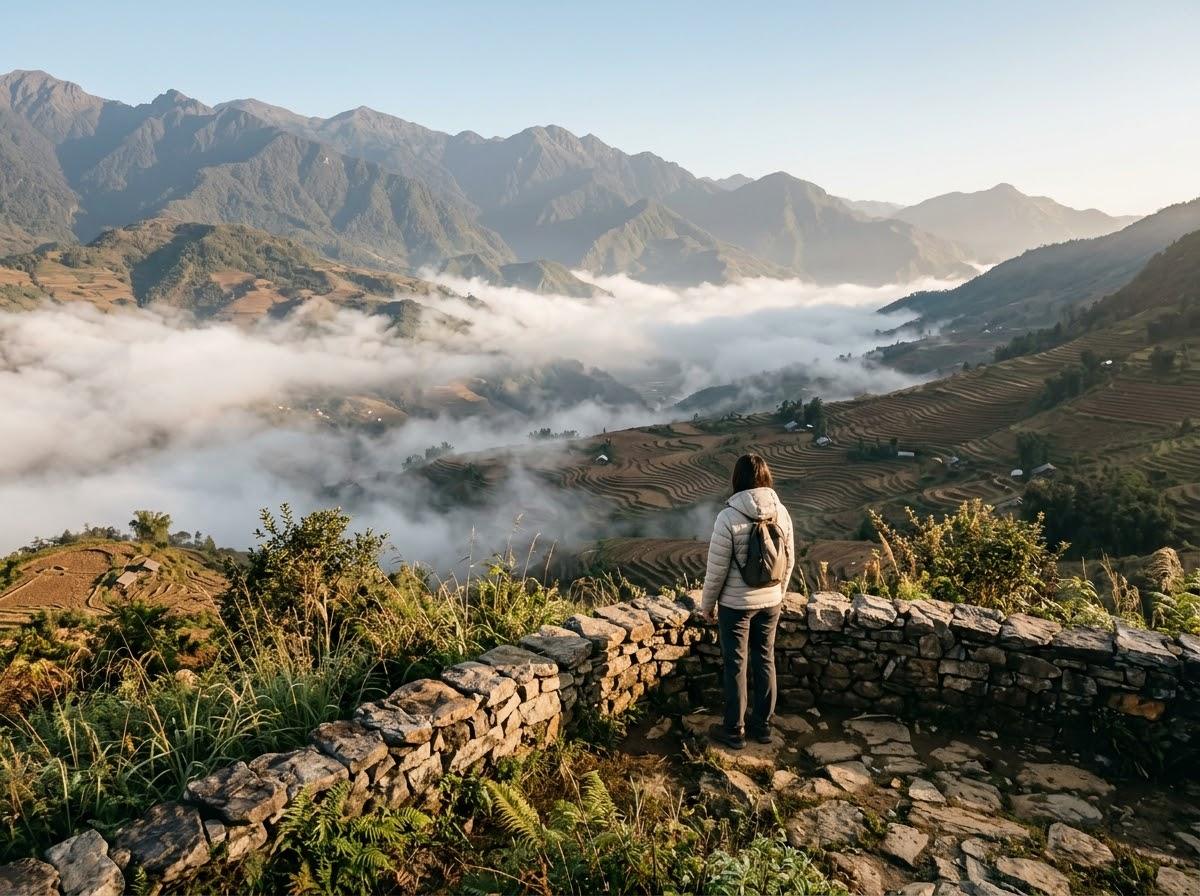
Cloud seas form on cool, calm mornings when the valley fills and the ridges stand clear. Early morning and late afternoon are best; strong wind or sun breaks them up. Fansipan, Ham Rong and the O Quy Ho pass are the classic viewpoints, and a 2025 travel guide also listed Pao’s Sapa among Sa Pa’s cloud-watching spots. The lead time is short, so stay at least two nights.
Snow in town is now rare, and Sa Pa’s winter Snow Festival uses artificial snow: the 2025 edition opened on 20 December at the Ethnic Cultures Park. The wider winter festival opened on 25 October 2025; 2026 dates had not been published by early October 2026.
What the weather means for your stay at Pao’s Sapa
At about 1.3 km from the Stone Church, Pao’s Sapa sits on the valley side of town, where the morning cloud often settles below the balconies. Valley-facing rooms on floors 2–7 get the best of it; our room guide explains which type is on which floor.
In winter the indoor pool, open 9 am to 8 pm and listed as heated, and the spa’s Red Dao herbal bath earn their keep. Guests have noted that some older air-conditioning units are slow to warm a room, so pack layers; the good-to-know page covers the rest.
What to pack
All year: a waterproof shell, shoes with grip and a warm layer for evenings. October to March: a down jacket, hat and gloves for early starts and the Fansipan summit, which is several degrees colder than town. June to August: a light rain poncho and quick-drying trousers for muddy trekking paths.
Questions about Sapa weather
Does it snow in Sapa?
Rarely in town. Snow fell in Sa Pa town in December 2014 and January 2016, but it has not been widely reported since. Frost and the occasional light snow are more common on Fansipan, at over 3,100 m, between late December and February. The town’s winter Snow Festival uses artificial snow.
Is October a good month to visit Sapa?
Yes. October brings highs around 19°C, lows around 14°C and much less heavy rain than summer, so trekking and views are good. The golden rice is mostly harvested by mid-October, though, so the terraces look brown. For golden fields, come in the second half of September instead.
How cold is Sapa in December and January?
Daytime highs average about 12–13°C and nights 6–7°C, with cold snaps that drop close to or below freezing. The Fansipan summit is much colder, often below zero at dawn. Pack a down jacket, hat and gloves, and choose a hotel with heating and warm indoor spaces.
When is the rainy season in Sapa?
From May to September, peaking in July and August with more than 450 mm a month and rain on most days. Rain usually comes in heavy afternoon bursts. The terraces are green and beautiful, but trails are muddy, Fansipan is often in cloud and landslides can close mountain roads after storms.
What is the best time to see the sea of clouds in Sapa?
October to March, with November and December the photographers’ favourites. Go out at dawn or late afternoon on a calm, cool day after rain. Fansipan, Ham Rong and the O Quy Ho pass are the best-known viewpoints, and valley-facing hotel balconies on the Muong Hoa side can catch it too.
Read first: Pao’s Sapa: good to know · Pool, spa and dining at Pao’s Sapa
Climate averages from the Sa Pa station record (1,570 m). Snow, frost, festival and seasonal details checked October 2026; mountain weather changes quickly.