
Sapa’s rice terraces carry a single crop each year, so how they look depends entirely on the month. Farmers flood the fields from late April to May, the water-mirror season; the young rice is green from June to August, brightest in July; and it ripens to gold from late August to late September, usually peaking in the first half of September in the Muong Hoa valley. Harvest is over by early October, and from then until spring the steps hold only stubble and bare earth.
The widest views are around Lao Chai and Ta Van, about 10 km from town, the heart of a national scenic site recognised in 2013.
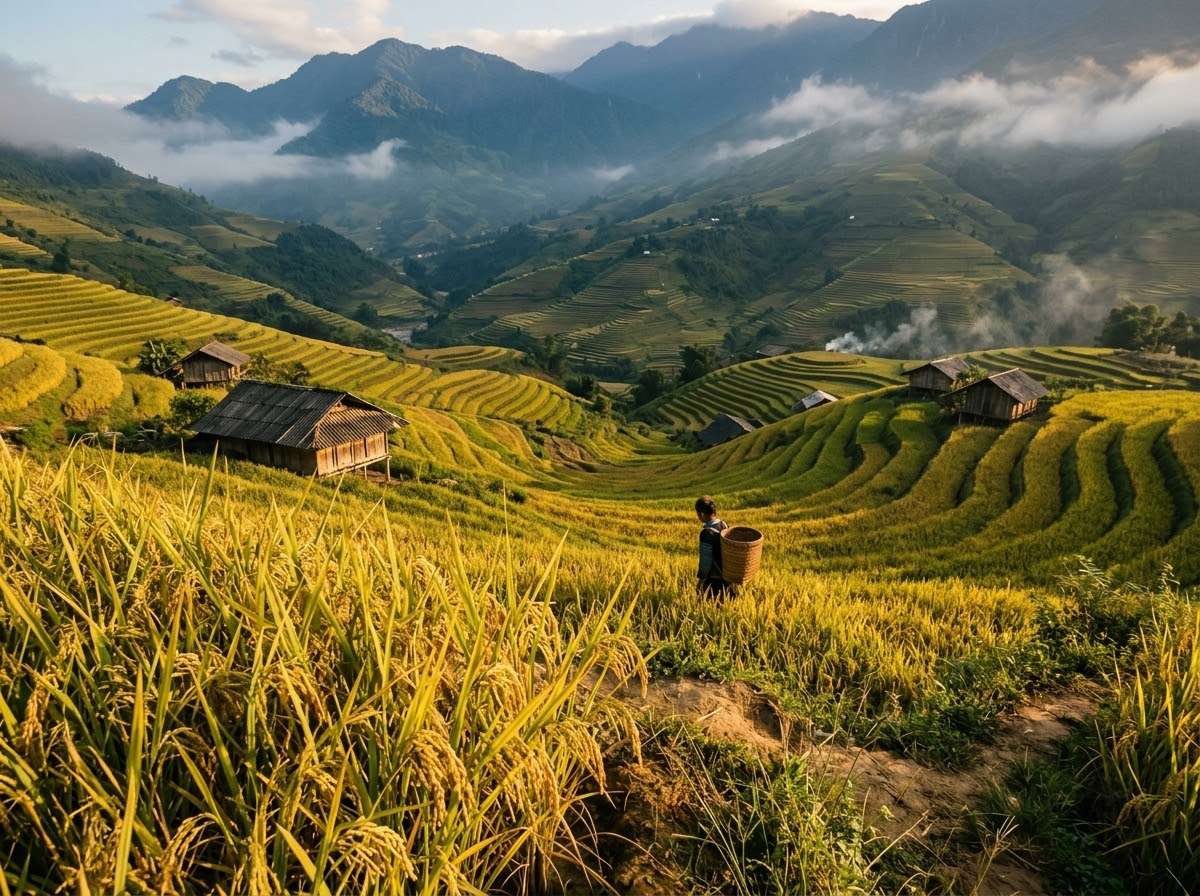
The Sapa rice terrace calendar, month by month
Sa Pa is high and cool enough that farmers grow only one rice crop a year, planted in late spring and cut in early autumn. Everything you see on the hillsides follows that one cycle. Exact dates move by a week or two from year to year with the rains, and villages higher up the slopes run later than the valley floor.
| Months | What the terraces look like | Good for |
|---|---|---|
| Late April–May | Fields flooded and ploughed, reflecting the sky | Water-mirror photos |
| Late May–June | Seedlings going in; higher fields still flooded into early June | Planting scenes |
| June–August | Young rice, bright green, most vivid in July | Green panoramas, in the wettest months |
| Late August–September | Rice ripening to gold; valley peak usually 1–15 September | The classic golden view |
| Late September–early October | Harvest; higher fields cut last | Harvest activity |
| October–November | Cut stubble and drying straw | Clear trekking weather, cloud season |
| December–February | Bare, brown terraces; plum and peach blossom in villages | Quiet trails, terrace shapes |
| March–April | Ploughing and seedbed preparation | Watching the fields being readied |
The green months line up with Sa Pa’s heaviest rain, and the golden weeks with the tail end of it. Our month-by-month weather guide has the rainfall and temperature figures to set against this calendar.
When to see the golden rice
The golden season is what most people come for, and it is short. In the Muong Hoa valley the fields usually begin to colour in the last days of August, are at their richest in the first half of September and are being cut by the end of the month. In 2025 the provincial newspaper reported Ta Van golden in the first week of September. Fields higher up ripen later and can hold some colour into early October.
Planning a 2027 trip
The 2026 harvest is finished. For 2027, aim for roughly 1–15 September around Lao Chai and Ta Van and keep a couple of days spare, because a cool, cloudy summer can push ripening back. Late August to early September is also the most famous and busiest stretch of the year, so village homestays and valley-view rooms go early.
Festivals in the golden season
Each year in late August and early September, Ban May village at Sun World Fansipan Legend, by the foot of the cable car, holds a golden-season festival with harvest re-enactments, green rice flake (com) making and five-colour sticky rice. The 2026 edition ran from mid-August to early September within the Sa Pa Autumn Festival, which also hosted the Vietnam Mountain Marathon on 17–20 September. Dates for 2027 had not been announced by October 2026.
Water season: late April to May
The flooded terraces draw fewer visitors and reward photographers just as well. Provincial reporting puts the best of it from late April to mid-May, once early-summer rain fills the fields, with higher villages still flooded into early June. Suoi Thau, in the former Lien Minh commune, is a known spot for it.
Where to see the terraces near Sa Pa
| Place | From town | Why go |
|---|---|---|
| Lao Chai and Ta Van | About 10 km; 35–40 min by road | Widest, most continuous panoramas |
| Y Linh Ho | About 7 km | Terraces on the trail down into the valley |
| Hau Thao and Sau Chua | Upper valley slopes | Quieter and more rustic |
| Cat Cat | Walkable from the centre | Fields beside the village and waterfall |
| Fansipan cable car | From Sun Plaza in town | High view across the valley on clear days |
The Ta Van, Hau Thao and Lao Chai complex covers nearly 1,000 ha, and Ta Van’s terraces alone more than 700 ha. The best way in is on foot: our Muong Hoa valley trekking guide follows the trail from Y Linh Ho down through Lao Chai to Ta Van. For a shorter outing, Cat Cat village has fields along the path, and the Fansipan cable car looks down over the valley when the cloud lifts; the Muong Hoa funicular from Sun Plaza to the cable-car station takes about six minutes.
Ban Ho, about 20 km south, and Ta Giang Phinh, on the road towards Y Ty, also have terraces, but fewer visitors make the trip and there is little reliable seasonal reporting on them.
Mu Cang Chai and Y Ty: bigger terraces, separate trips
Vietnam’s best-known terraces are at Mu Cang Chai, about 140 km from Sa Pa, roughly four hours by car over the O Quy Ho pass. Since the July 2025 merger it sits in Lao Cai province too. Its terraces cover about 7,000 ha, became a national scenic site in 2007 and were declared a special national relic at the end of 2019. Treat it as a trip of its own, with at least one night there, rather than a day out.
Closer to Sa Pa, the The Pa terraces at Y Ty, a national heritage site of about 233 ha, lie some 70 km away past O Quy Ho. They turn gold from mid-August to early September, a little ahead of the Muong Hoa valley, which makes them a useful back-up if you arrive early.
Photographing the terraces
Low side light shows the curve of each terrace wall; at midday the steps flatten into a single plane. As a rule of thumb, shoot from about 7:30 to 9:30 am and again after 3:30 pm. In autumn the morning fog in the valley often burns off by mid-morning, and harvest work tends to happen in the afternoon. For sunset, the O Quy Ho pass is the classic spot, roughly 4:30 to 5:30 pm.
Field paths are slippery early in the day and after rain, so wear shoes with grip and keep to the trails rather than the narrow terrace walls. The rice is someone’s harvest: walking through a ripe field damages it.
Seeing the seasons from Pao’s Sapa
Pao’s Sapa stands where Muong Hoa road leaves town for the valley; the same road winds down to Lao Chai and Ta Van, and a few free viewpoints line its first stretch. Rooms facing the valley, on floors 2–7, look across the upper Muong Hoa valley: you see the season’s colour from the balcony, though not the famous close-up panoramas, which lie further down. Our room guide sets out which room type is on which floor.
On a terrace day, breakfast at A Linh Restaurant opens at 6:30 am, early enough for the morning light. A taxi to Ta Van cost about VND 200,000–300,000 (June 2025). Check-out is at noon and the hotel stores luggage, so a final-morning walk can fit before an afternoon bus. The Moana Sapa café, about 100 m away, is another easy valley lookout.
Questions about Sapa’s rice terraces
When are the Sapa rice terraces golden?
From late August to late September, with the peak usually in the first half of September in the Muong Hoa valley around Lao Chai and Ta Van. Higher villages ripen later and can still show gold into early October. The window shifts by a week or so each year, so build a spare day into your plans.
Are the Sapa rice terraces worth seeing in October?
Only in the first days of the month. By mid-October most valley fields are harvested, leaving stubble and drying straw rather than gold. October does bring cooler, clearer trekking weather and the start of the cloud season, so the valley walks are still rewarding; just do not expect golden rice.
Can you see rice terraces in Sapa in winter?
You can see the terraces, but not the rice. From December to February the steps are bare and brown, sometimes frosted at altitude, and villages have plum and peach blossom in January and February. The terrace shapes stand out clearly without crops, but it is not the green or gold scene in most photos.
How far are the rice terraces from Sapa town?
The main terraces at Lao Chai and Ta Van are a 35–40 minute drive (about 10 km) from town, or a day’s trek from Y Linh Ho, about 7 km out. Fields near Cat Cat are within walking distance of the centre, and the Fansipan cable car gives an aerial view. Mu Cang Chai, about 140 km away, needs its own overnight trip.
Is Sapa or Mu Cang Chai better for rice terraces?
Mu Cang Chai has the larger terraces, about 7,000 ha, and is a special national relic, but it is roughly four hours by car from Sa Pa. Sa Pa pairs good terraces with trekking, the Fansipan cable car and a wide choice of hotels. With three days or fewer, stay in Sa Pa; with a week, you can do both.
Read first: Pao’s Sapa rooms, compared · Getting to Pao’s Sapa
Season dates from provincial press and local guides; the harvest calendar shifts with each year’s weather. Festival, distance and taxi details checked October 2026.